Grease-resistant paper and KIT
For burgers, sandwiches, fatty pastries and tray liners, we select the required grease barrier. KIT is a grease-resistance test result, not a material name or proof of heat resistance.
Explore grease-resistant papers →
Food wrapping papers for meat counters, cafés and takeaway service. We select grease resistance, moisture protection, format and printing according to what and how you pack.
Request a food paper quoteSheets or rolls. Printed or plain. We will confirm the specifications together.

Fat, moisture, temperature and contact time determine the protection required. One paper may not suit dry bread, juicy meat products and hot burgers equally well.
For burgers, sandwiches, fatty pastries and tray liners, we select the required grease barrier. KIT is a grease-resistance test result, not a material name or proof of heat resistance.
Explore grease-resistant papers →A polyethylene layer adds a moisture and grease barrier. We consider it for wrapping meat, cheese and other moist or fatty foods where the conditions of use are suitable.
Explore PE-coated paper →Food-contact uncoated paper may be sufficient for short-term wrapping of dry, low-fat products. White or brown colour and MG or MF surface finish are separate choices.
Compare applications →| What are you packing? | What should you consider? | What needs to be specified? |
|---|---|---|
| Dry bread and low-fat bakery products | Uncoated MG or MF paper suitable for food contact. | Fat and moisture content, packing temperature and time in the packaging. |
| Burgers, wraps or fatty pastries | Paper with the required grease resistance; KIT is one selection criterion. | Sauces, steam, food temperature, serving on a tray or wrapping around the food. |
| Fresh meat, cheese and moist deli products | PE-coated food paper or another suitable barrier paper. | Juices and fat, chilled storage, direct contact and required protection duration. |
| Tray or food-box liners | Grease-resistant paper selected for the food placed on it. | Whether food touches the paper directly; print position, coverage and permitted contact. |
| Oven baking | Dedicated baking paper rated for the required temperature and duration. | Oven type, maximum temperature and heating time. Ordinary food wrapping paper does not replace baking paper. |
A correctly sized sheet makes folding and wrapping easier. An outside logo or pattern gives even a simple wrapper your business identity.
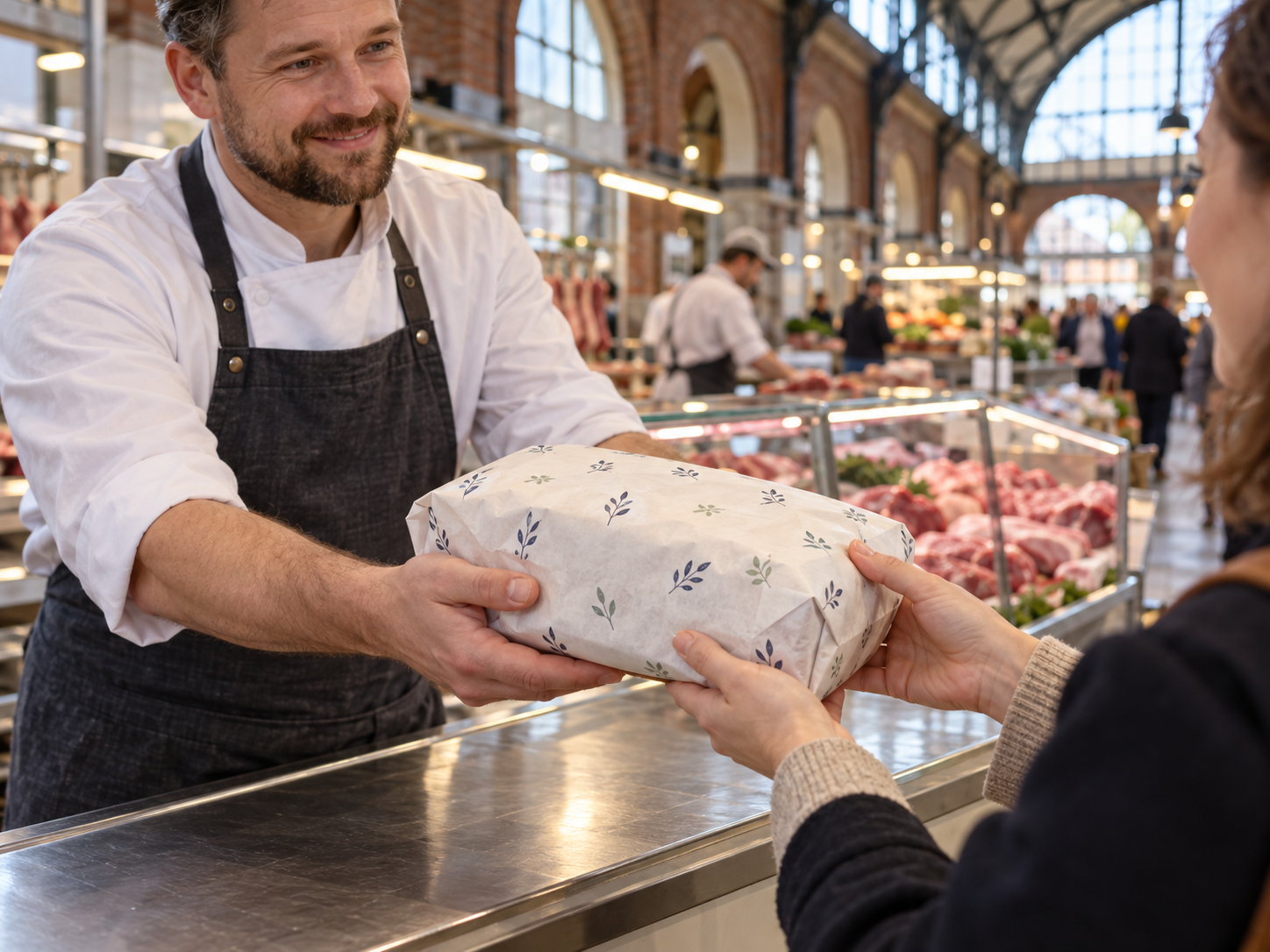

MG and MF describe surface finishes. KIT indicates a grease-resistance test result. PE identifies a plastic coating. These describe different properties and can occur together in one material.
If your current paper leaks grease, gets wet or tears, include a sample or photo and describe the situation.
Print suitability depends on the complete system: paper, coating, ink, design, food, temperature and time. Low print coverage or water-based ink does not by itself establish suitability for direct food contact.
As a standard approach, we place printing on the outside. If food will touch the print directly, the complete solution must be selected and documented for that use.
PE-coated paper combines paper fibres with a plastic layer. During fibre recycling, non-fibrous components must be separated; the coating structure can make fibre recovery harder and increase the amount of rejected material.
This does not mean every PE-coated paper is unrecyclable. The material’s test results and its acceptance in the destination market’s collection and processing system matter.
You do not need every answer in advance. Include a sample or photo of your current paper and we will help clarify the choices.
Request a food paper quoteIt indicates a better result in the relevant grease-resistance test, not every aspect of performance. Moisture, heat, folding and actual contact duration need separate consideration.
No. MG describes the surface finish. Grease resistance and food-contact suitability must be confirmed separately from the material data.
A suitable food-paper construction may be. We consider meat juices, fat, chilled storage and contact duration and check the material’s conditions of use.
Not on the basis of grease resistance alone. Choose paper whose documentation permits the required oven temperature and duration. The same applies to microwave use.
Only if the complete printed solution is suitable and documented for that purpose. Ink intended for an outer surface is not automatically suitable for direct food contact.
No. Recyclability depends on the complete composition, barriers, additives and local processing. Neither the absence of PE nor a KIT rating proves it alone.
Pre-cut sheets provide a consistent format. Rolls suit variable lengths or compatible packing equipment. We consider handling, material use and machine dimensions.
Yes. Send the logo or artwork with colours, coverage and the intended printed side. We confirm technical feasibility and food-contact conditions before production.
Send the application, size and quantity. We will help select the material and printing.
"*" indicates required fields