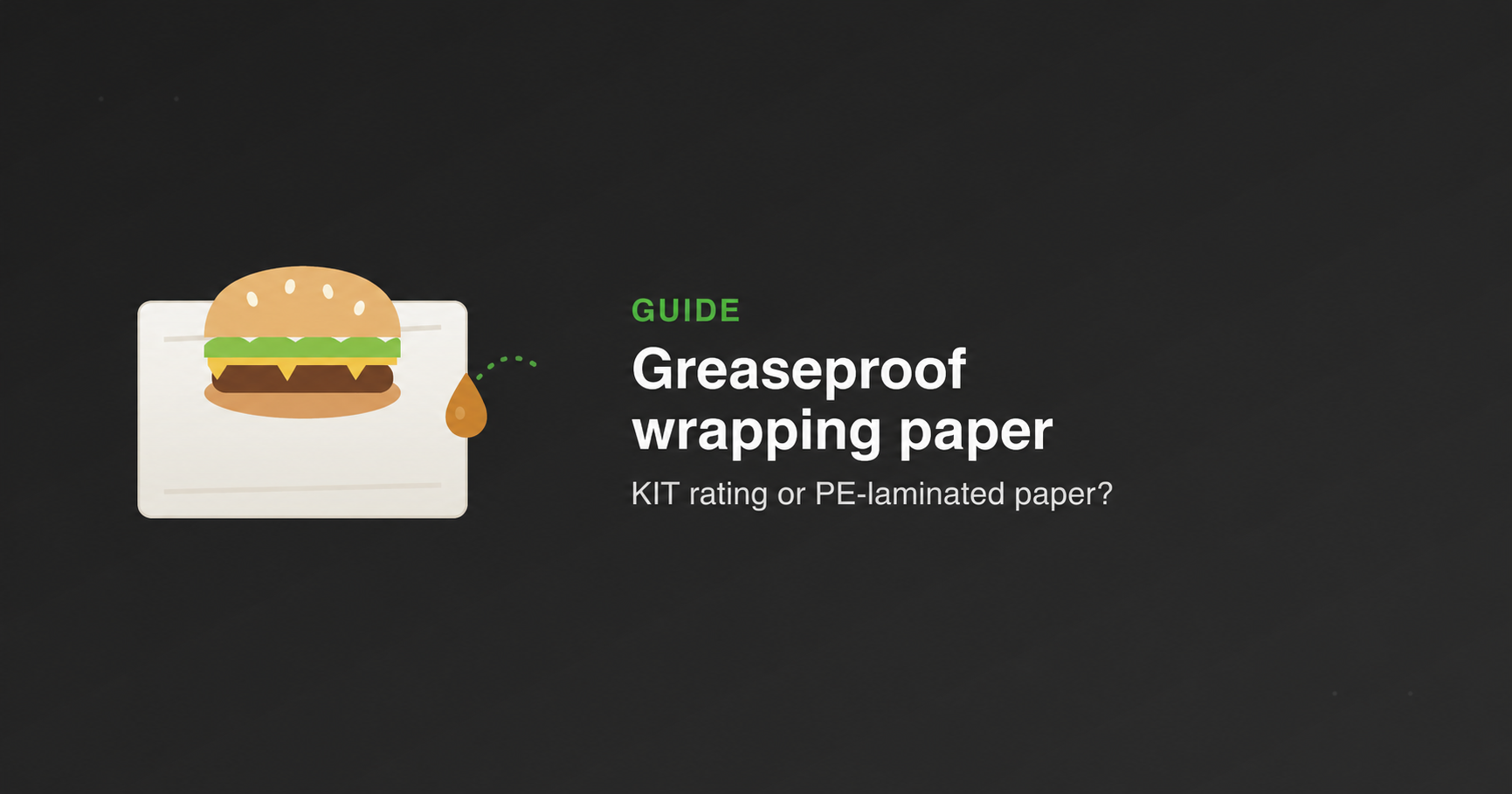
When choosing greaseproof wrapping paper, distinguish between grease resistance, moisture resistance and sealing properties. This article compares papers with a grease-resistance KIT rating and papers with a PE layer. KIT describes a test result, while PE describes a material layer, so these are not two mutually exclusive material types.
What is a KIT rating?
The KIT test (TAPPI T 559) assesses the resistance of a paper surface to test liquids. The KIT rating expresses the test result: a higher number means greater resistance in this test. The appropriate level is selected for the specific food, contact time and conditions of use; a KIT rating alone does not establish water resistance or suitability for food contact.
A KIT rating does not describe the chemical composition of the paper or prove that it is plastic-free. The coating composition and material recyclability must be checked separately. The appropriate collection method depends on the complete packaging, its cleanliness and local waste-management guidance.
Greaseproof paper is used, for example, to wrap burgers, rolls, chips and bakery products. Suitability depends on moisture, temperature and contact time as well as fat content.
What is PE-laminated paper?
PE-coated paper combines paper with a polyethylene layer. A suitable PE layer helps protect against grease, moisture and liquids and may allow heat sealing. Actual barrier and sealing properties depend on the layer thickness, structure and conditions of use.
The recyclability of PE-coated paper is assessed for the complete material structure. A combination of paper and plastic may require appropriate processing technology. Follow local sorting instructions when choosing a collection container; a high paper content alone does not establish suitability for every paper recycling stream.
PE-coated paper may be suitable for packaging moist and greasy foods and for making heat-sealable structures. For products containing liquids, the leak resistance of the seams and the complete packaging must also be checked.
When should you choose each option?
For greasy products, start by selecting paper with suitable grease resistance. If moisture, liquids or heat sealing are also involved, compare the relevant barrier and sealing properties. Price and environmental impact depend on the specific solution; neither a KIT rating nor a PE layer alone makes one option consistently cheaper or more sustainable.
Questions to ask the customer
- Is the product greasy, wet or both?
- Will the packaging come into contact with liquids such as sauces, juices or ice?
- Does the packaging require a heat-sealed seam or closure?
- How important is recyclability to the customer compared with maximum barrier performance?
- What is the product temperature during packing and consumption: hot, cold or room temperature?
These five questions generally provide enough information to guide the customer towards the right material during the first conversation.
Do you need help choosing the right material for a specific product?
Write to us →