Packaging your competitors do not have
We have added a Central European flexible packaging manufacturer to our network — one that designs packaging around your product, packing line and retail shelf, rather than selling a standard bag.
Flexible paper
Plastrum has added a Central European flexible packaging manufacturer to its network. Rather than making a standard bag more cheaply, this manufacturer designs packaging around the customer’s product, packing line and retail shelf. Its portfolio includes solutions rarely seen on Baltic retail shelves.
Most packaging enquiries begin with price. But packaging that looks exactly like a competitor’s does little for a customer on the shelf beyond protecting the product. Our new partner starts from the opposite direction: first product protection and packing-machine requirements, then the material structure, and only then printing. The result is packaging with differentiation
built in
, rather than stuck on.Windows, mesh, handles, perforations and ventilation are not decorations. They are selling points that work even when the shopper does not read the packaging.Four material directions under one roof
The manufacturer groups its solutions into four clear directions. Customers need not simply choose between plastic and paper: they can choose what makes sense for their particular product and target market.
01 — Flexible paper
Paper-based flexible packaging
-
Paper-based flexible packaging whose compatibility with an existing packing machine needs to be tested. Recyclability and collection methods depend on the complete structure and the target market’s collection system.
paper wrappers and bands
paper packaging for frozen products
- solutions for horizontal and vertical packing machines
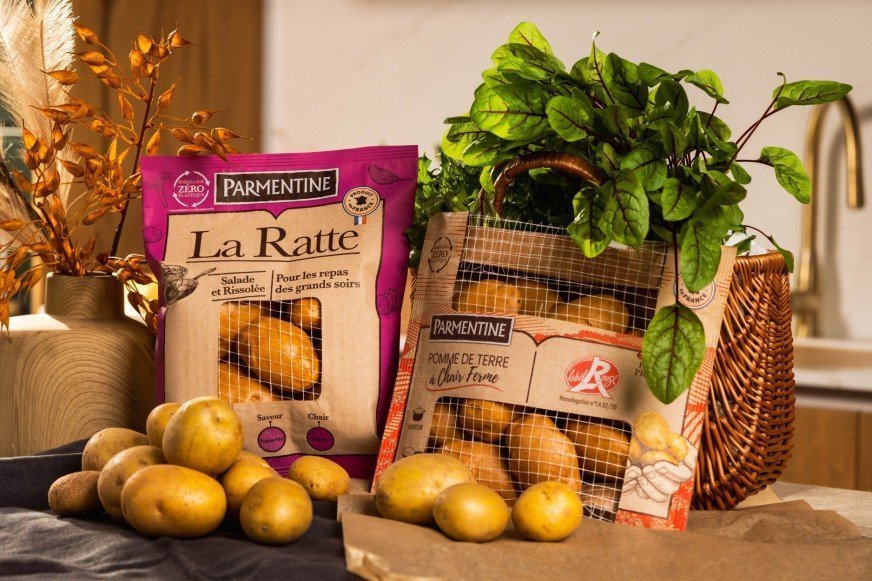
- packaging with cellulose windows (1–4 windows)
- combinations of paper and organic fibre mesh
- basket-style packaging with a carrying handle
- 02 — Compostable
- Packaging from renewable raw materials
-
Compostability without losing functionality — including barrier performance, transparency and windows.
compostable film and paper bags
high-barrier compostable laminates
- window and drawstring solutions
- transparent compostable films
- variants described as suitable for home composting
- organic and compostable meshes
- 03 — Mono-material
- Construction from a single material family
-
Film, mesh and finishing components made from the same raw material simplify sorting and make mechanical recycling a practical possibility.
transparent, opaque and coloured films
film and mesh from one material family
- translucent bags on a roll
- structures suitable for perforation
- carrying-handle solution
- product weight up to approximately 2.5–3 kg
- 04 — Ecodesign
- Reduced material use
-
The same protection with less raw material. Suitable when the aim is a measurable reduction in impact rather than eliminating plastic.
thinner films and reduced packaging weight
approximately 20 µm r-PET top-seal lidding films
- paper and mesh with a plastic content below 5%
- lightweight window packaging
- high barrier performance with less material
- barrier solutions with a metallised inner layer
- Technologies that turn packaging into a selling point
- Differentiation comes from details shoppers notice before reading the label: how the pack opens, whether the product is visible, whether the packaging breathes and whether it can be resealed.
Custom windows and laser cutting
— shape and position tailored to the product, with mesh bonded only beneath the window
- Flexographic printing in up to 10 colours — water-based inks and controlled colour consistency
- Digital printing — short runs without printing-plate costs, seasonal and promotional packaging, and multiple designs in one batch
- Easy opening and resealing — opening scores and open/close solutions
- Micro- and macro-perforation — ventilation and perforations for microwave use
- One-way degassing valves — for roasted coffee and fermenting products
- Lamination and sealing — the adhesive system is selected for the materials; solvent-free and water-based lamination are different processes. Cold sealing and heat sealing describe packaging closure methods
- Construction options — pillow bags, bags on a roll, sachets, cones, resealable bags and wrappers
- Who benefits mostThe strongest effect is for manufacturers whose products sit alongside visually similar alternatives: fresh fruit and vegetables, bakery and confectionery products, frozen food, roasted coffee, pet food, dry goods and snacks. Especially when packaging must show the product, allow it to breathe and remain sortable within a single material stream.
A practical advantage is that new packaging need not immediately be ordered in large quantities. Digital printing allows the design and construction to be tested in the market on a smaller scale before moving to a large flexographic run. This considerably reduces the risk of launching new packaging.
Plastrum’s note on environmental claims
We do not sell slogans. Every claim of compostability or recyclability must relate to a specific package and target market: does the certificate cover the complete packaging or one layer; is it suitable for home or industrial composting; what are the actual oxygen, water-vapour and grease-barrier properties; and does the destination country’s collection system actually accept the material? Plastrum checks this information and certificate validity before preparing a quotation, including in light of PPWR requirements.
Request samples before deciding
Material and construction cannot be assessed from a catalogue photograph. We can arrange physical samples of solutions suitable for your product and have them tested on your packing line.
samples in selected materials and constructions
quotation with quantity tiers
- technical compatibility check with your existing packing machine
- certificates and material composition documentation
- Request samples and a quotation
- Speak to a technical adviser
undefinedundefined