Guide · Print files
The artwork file can determine the price before anyone opens it
An extra colour can increase prepress and production costs. The price impact depends on the printing technology, run length and ink coverage. You cannot see this on screen; you can see it only in the file. Five minutes of checking before requesting a quote can prevent an inaccurate price and an awkward correction later.
Guide · Print files and quotes
Two colours in one file — and the packaging price changes
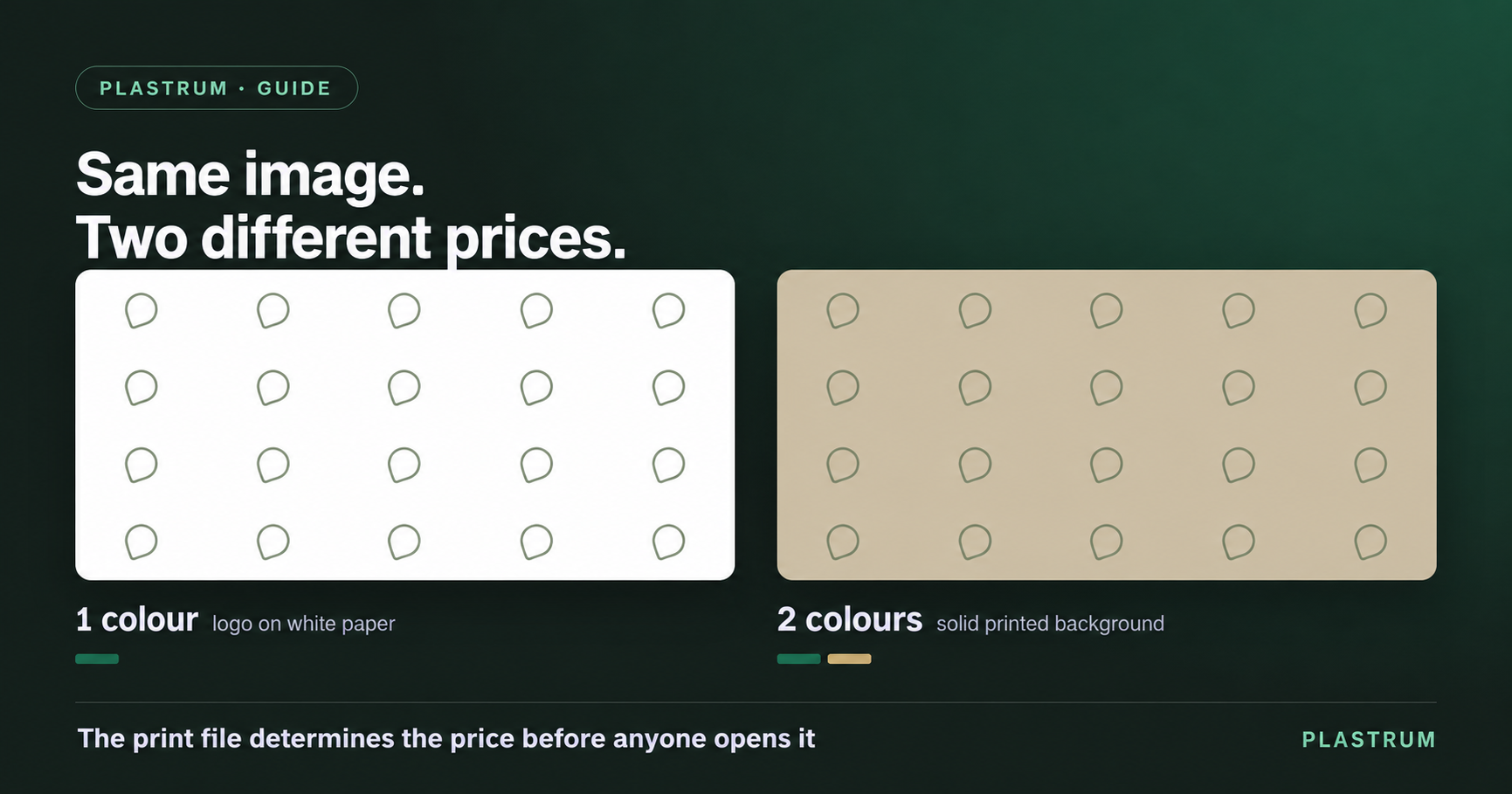
A customer sent us print-ready artwork for tinted tissue paper: a warm beige background with a light logo pattern on top. The enquiry said “one colour”. The file said otherwise. The difference was an entire additional ink colour, another set of printing plates and a production risk no one had accounted for.
Packaging quote requests almost always begin with a few words: product, dimensions, quantity, “one colour, logo”. The artwork file is attached, but no one opens it. It goes to the manufacturer, who opens it only after the price has already been quoted to the customer. That is when the most awkward corrections arise: the price goes up not because the raw material has become more expensive, but because the job required more from the outset than the enquiry described.
In this example, the background was designed as a solid block—100% ink coverage across the entire sheet, edge to edge. On screen, it looks exactly like coloured-through paper. The file makes the difference clear: two separate colour separations instead of one.
Coloured paper and a colour printed on white paper look identical on screen. At the print shop, they are two different jobs with two different prices.
Four things to check in the file before requesting a quote
These four checks take about five minutes. You do not need design software; simply open the file and look in the right places.
-
01 — Colour separations
How many print colours are actually in the file
This is the most important number in the entire enquiry. In flexographic printing, each separate print colour generally requires its own plate and print station. Several colours may be printed in a single pass; digital printing does not use plates.
- Count spot colours by their names, not by appearance
- Check whether any colour is used on just one element
- Check whether CMYK and spot colours are mixed
- Ask whether any colour is unnecessary and can be combined
-
02 — Solid block or substrate
Is the background printed, or is it the paper itself
The appearance can be the same, while the production method, price and risk are entirely different. No one asks this question automatically, so make sure to ask it.
- A full-page filled object in the file means the background is printed
- Coloured-through substrate means the material comes from stock in that colour
- Check the stock shade against the desired Pantone colour using a physical sample
- Closest stock shade plus a sample for approval
-
03 — File geometry
Trim, bleed and the actual page size
A quick check that can prevent an entire print run from being redone. The three boxes must match.
- Trim = the finished page size
- Bleed is usually 3 mm on all sides
- The TrimBox is the finished size; the BleedBox includes the bleed area. The MediaBox covers the entire PDF page and may also include print marks.
- A repeating pattern must line up at the edges
-
04 — Ink coverage and material
Can the material handle this level of ink coverage
Lightweight paper and high ink coverage are a poor combination. Manufacturers often flag this only after the order has been placed.
- A solid block can show through thin paper
- Excess ink can cause the sheet to curl
- Ink can crack when folded or creased
- Uneven drying at higher production speeds
Terms that directly affect the price
These terms must mean the same thing to both sides in the enquiry and the quotation. If any of them is unclear, the price is unclear too.
- Colour separation — one printing plate per colour; the number of separations equals the number of print colours.
- Spot colour — a pre-mixed ink, not made from CMYK; provides a consistent, repeatable shade.
- Solid block — 100% coverage across the entire surface; the most demanding print method on lightweight material.
- Pre-coloured substrate — the material is coloured during production, so no ink is added in printing.
- Printing plate (flexographic plate) — generally one for each print colour in flexographic printing; reuse and any replacement cost depend on the plate’s condition and the manufacturer’s terms.
- Bleed — artwork extending beyond the finished size to allow for trimming, usually 3 mm; without it, a white edge may remain.
- Ink coverage — the proportion of the surface covered with ink; it affects both ink consumption and how the material behaves.
- Registration — the alignment of colours; a pattern without precise registration costs less than accurately aligned printing.
Who stands to save the most
The difference matters most on short runs, where plates and setup make up a large share of the price. This includes wrapping and tissue paper, carrier bags, printed packaging tape, labels and seasonal packaging. On a small order, one unnecessary print colour can account for a tenth of the total order cost.
The same applies to brands whose designs are created by an agency and sent with the packaging enquiry unchanged. The agency designs the appearance, not the production method — and that is exactly the right division of work. The only question is who opens the file in between.
A note from Plastrum
We do not alter the customer’s design or tell the designer what to draw. We open the file before the price enquiry is sent and explain what it contains: how many colours it uses, whether the background is printed or the material’s own colour, and whether the coverage suits the chosen paper weight. If the solution costs more than necessary, we suggest an alternative and show the difference in figures, so the customer can decide before the print shop raises the issue later.
The match between an available stock shade of coloured-through paper and the desired Pantone colour must be confirmed with a physical sample. If the stock shade is unsuitable, we will check with the manufacturer whether custom colouring is possible, along with the colour tolerance and minimum order quantity.
Send the file before the enquiry, not afterwards
We review the print file before the price enquiry is sent. The review is free and takes one business day.
- the number and names of colour separations
- whether the background is printed or the material’s own colour
- trim, bleed and whether the dimensions match
- whether the ink coverage suits the chosen material and paper weight
- a suggestion for reducing the number of colours or the cost
Berni · Plastrum · berni@plastrum.ee